This is the third part of our series on the AI boom. First we asked whether AI is heading for a dot-com style burst. Then we looked at whether Anthropic's record IPO was proof of a bubble or real value.
This week, the stock market gave its own answer, at least for now. The AI trade cracked.
What happened in the markets?
Friday, November 20, was one of the worst days of the year for technology shares:
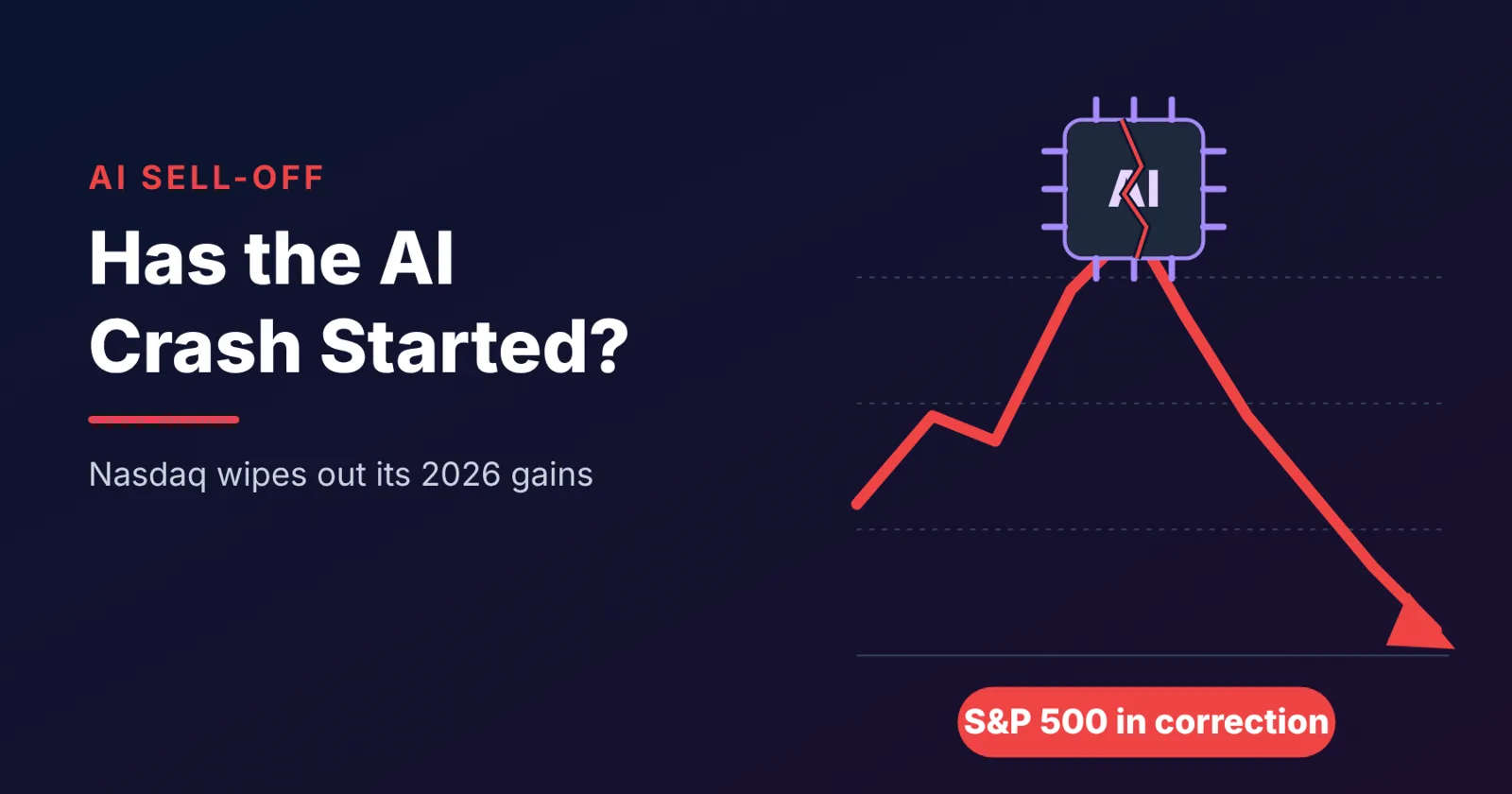
- The Nasdaq erased its 2026 gains. The tech-heavy Nasdaq Composite fell about 3.6% on Friday and is now down almost 1% for the year.
- The S&P 500 is in correction. It fell for a seventh straight session, its longest losing streak since February 2020, and is now about 10% below its August peak. A fall of 10% or more from a recent high is what investors call a "correction".
- The worst week of the year. All three major US indexes were on track for their worst week of 2026.
Different data sources reported slightly different figures for the size of Friday's fall, but every measure tells the same story: a sharp, broad sell-off led by AI and chip stocks.
Nvidia: the biggest casualty
Nvidia, the company whose chips power most of the AI boom, was hit hardest. Its shares reportedly fell 14% on Friday, closing a seventh straight losing week. Over that run, the stock is down around 46%.
The sharpest drop came after Reuters reported that the US Securities and Exchange Commission (SEC) is examining accounting issues at the company. An investigation is not proof of wrongdoing, but in a nervous market, the report was enough to trigger heavy selling.
Anthropic's IPO shine fades
Only last week, Anthropic's listing was celebrated as the largest IPO in history. On its first day, the shares opened about 34% above the $83 IPO price.
That excitement has almost completely faded. The stock fell about 11% on its second day of trading and almost 13% on Friday, trading near $84.70, barely above its IPO price.
As we noted in our previous article, the IPO was a test of how much investors were willing to pay for AI. The market's first verdict is clear: much less than on day one.
(Disclosure: this article was drafted with the help of Claude, an AI model made by Anthropic.)
Why is the AI trade falling now?
Several pressures have hit at the same time:
1. Doubts about the AI rally
Analysts say that once Anthropic's IPO was completed, doubts about how long the AI rally could last came to the surface. One analyst called the sell-off "a meltdown", pointing to how much bearish sentiment has built up around tech and AI.
2. Higher interest rates are coming
US inflation remains stubborn, and markets now expect the Federal Reserve to raise interest rates at its December meeting. Higher rates hurt expensive growth stocks the most, because their value depends on profits expected far in the future.
3. Accounting worries
The reported SEC probe into Nvidia has made investors more nervous about the quality of earnings across the AI sector, which was already under scrutiny because of so-called circular financing deals.
4. A flight to safety
Investors have been moving money out of risky assets and into bonds and defensive stocks such as healthcare and consumer staples. The US dollar is heading for a fourth straight weekly gain.
Is this the AI bubble bursting?
It is too early to say for sure. But here is how this week compares with the dot-com crash we wrote about earlier:
- What looks similar: Fast-rising valuations, huge spending on infrastructure, heavy hype and now a sudden loss of confidence once a big milestone event (the Anthropic IPO) passed.
- What looks different: In 2000, many dot-com companies had almost no revenue. Today's leading AI companies are earning tens of billions of dollars. Nvidia's shares now trade at about 8.4 times its expected earnings, a much lower multiple than during the dot-com peak.
- The strange split: While public AI stocks are falling, private AI startups are still being valued higher. Coding startup Cognition is reportedly in talks at a $75 billion valuation, and Databricks at $225 billion. If public markets stay weak, those private valuations could come under pressure next.
The most balanced view is this: the market is repricing AI, not rejecting it. A correction can wipe out a lot of value without ending the technology, just as the internet kept growing after the dot-com crash.
What does this mean for Pakistan?
Even if you don't own US stocks, this matters:
- Emerging markets are under pressure. Emerging-market stocks have slid about 20% from their record as global investors pull back from risk.
- A stronger dollar hurts. When the dollar rises, imports, fuel and foreign debt payments become more expensive for countries like Pakistan.
- Gold is falling too. Some investors have been selling gold to cover losses on AI stocks, which helped push gold prices in Pakistan to a 14-month low.
- Tech jobs and freelancing: If AI companies cut spending, demand for outsourced tech work could slow. On the other hand, cost-cutting can push more work towards lower-cost markets like Pakistan.
What to watch next
- The Fed's December 8 to 9 meeting: A rate hike is widely expected. Any hint of a pause could calm markets.
- US inflation data on December 10: Softer inflation would ease the pressure.
- Nvidia and the SEC: Any details from the reported probe could move the whole sector.
- Anthropic's IPO price: If the stock falls below $83, it would be a powerful symbol of fading AI enthusiasm.
Frequently asked questions
Has the AI bubble burst?
Not officially. The Nasdaq has erased its 2026 gains and the S&P 500 is in correction, but it is too early to say whether this is a short correction or the start of a longer crash.
Why did Nvidia stock fall?
Nvidia reportedly fell 14% on Friday after Reuters reported an SEC accounting probe, extending a seven-week losing streak.
Why did Anthropic stock fall after its IPO?
The shares fell as the wider AI sell-off deepened and early excitement faded. On Friday they traded near $84.70, just above the $83 IPO price.
What is a stock market correction?
A correction is a fall of 10% or more from a recent peak. A fall of 20% or more is usually called a bear market.
The bottom line
The AI boom has hit its first serious test. Rising interest rates, accounting worries and a fading IPO have shaken confidence. Whether this becomes a dot-com style crash or just a healthy correction depends on what comes next: the Fed's decision, the earnings of AI companies and whether real AI revenue can keep growing fast enough to justify the spending.
Disclaimer: This article is for information only and is not investment advice. Markets are volatile. Always do your own research or consult a qualified financial adviser.