Pakistan's debt is a topic that rarely makes everyday headlines, but it affects almost everything: taxes, inflation, fuel prices, jobs and the value of the rupee.
The Finance Division has released its latest Debt Sustainability Analysis for fiscal years 2027 to 2029. The headline is mixed. Pakistan's debt situation is improving, but it remains fragile. The report warns that if several things go wrong at once, debt could climb back to more than three-quarters of the economy.
How much debt does Pakistan have?
At the end of June 2026:
- Total public debt: Rs86.7 trillion, of which Rs59.4 trillion is domestic and Rs27.3 trillion is external
- Including guaranteed debt: Rs90.98 trillion, up from Rs84.77 trillion a year earlier
- Debt-to-GDP ratio: 72%, down from 74.3%
The debt-to-GDP ratio is the key number. It compares how much the country owes with the size of its whole economy. A falling ratio means the economy is growing faster than the debt, which is good news.
The good news
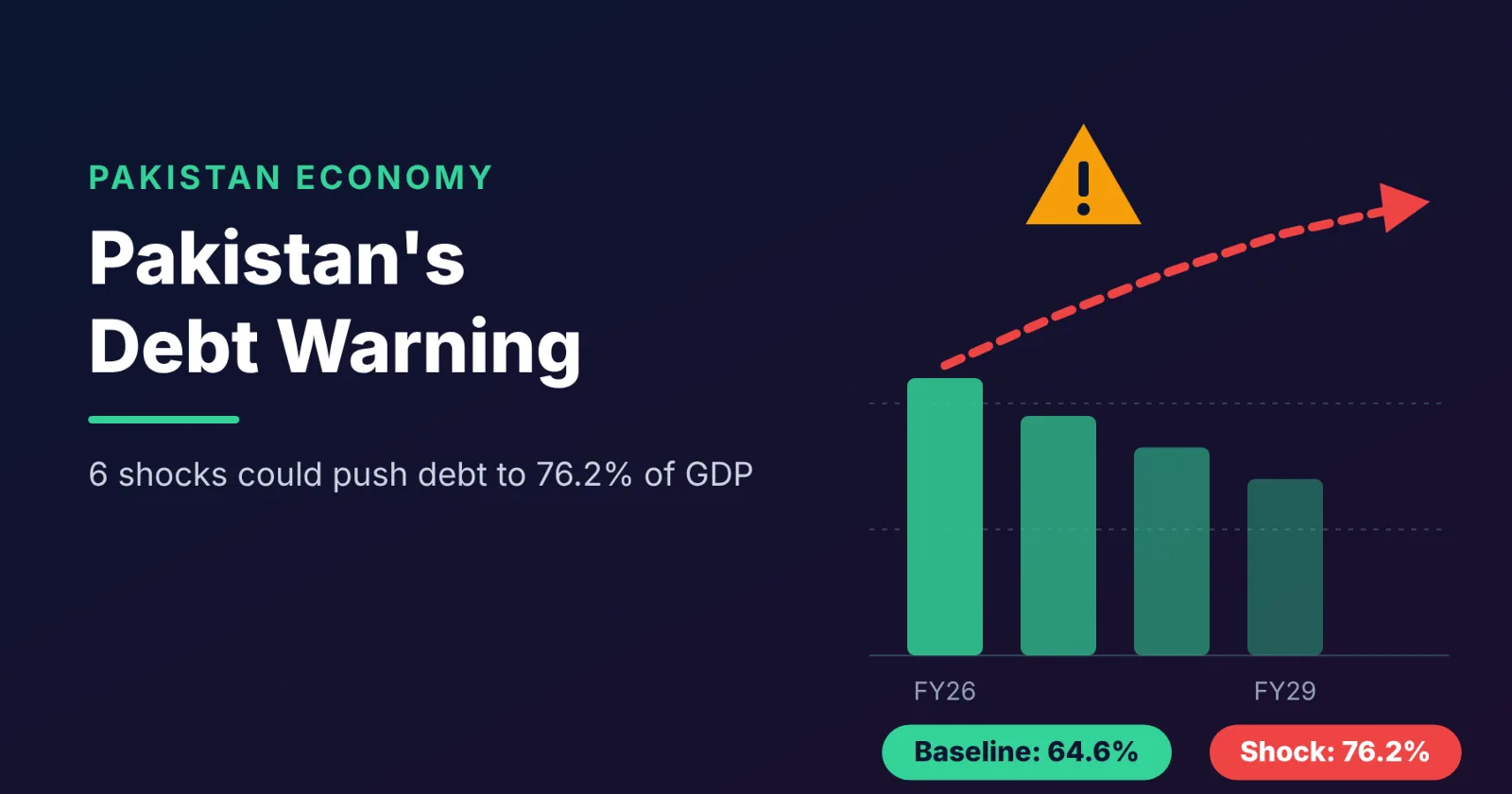
- Debt is falling as a share of the economy. Under the government's main forecast, debt is expected to fall to 68.6% of GDP in FY27, 66.9% in FY28 and 64.6% in FY29.
- Interest costs have dropped sharply. Interest payments fell by Rs1.94 trillion, or 21.8%, from Rs8.89 trillion in FY25 to Rs6.95 trillion in FY26. Lower interest rates at home made borrowing cheaper.
- External debt risk is under control. External debt makes up 31.5% of total public debt, below the 40% limit set to manage currency risk.
The warning: 6 shocks that could change everything
The report tests what would happen to Pakistan's debt if things go wrong. Here are the six scenarios:
1. A combination of shocks (the worst case)
If slower growth, higher interest rates, a weaker rupee and other pressures hit together, debt could rise to 73.6% of GDP in FY27, 75.1% in FY28 and 76.2% in FY29, instead of falling to 64.6%.
2. Slower economic growth
If the economy grows more slowly than expected, debt would stay stuck at around 70% to 71% of GDP through FY29.
3. Hidden debts in banks and state companies
If the government has to rescue struggling financial institutions or cover guarantees, debt could reach 73% of GDP by FY29.
4. A weaker rupee
A 15% depreciation of the rupee would push debt up to 71.8% of GDP in FY27, because foreign loans become more expensive in rupee terms. It would then gradually fall to 65.2% by FY29.
5. Overspending returns
If the government goes back to its historical habit of spending more than it earns before interest payments, debt would reach 70.2% of GDP by FY29.
6. Higher interest rates
A 3-percentage-point rise in interest rates would raise debt to 67.5% in FY28 and 66% in FY29. This is the mildest shock, but it matters because most of Pakistan's domestic debt is exposed to rate changes.
A hidden risk: floating interest rates
About 73% of Pakistan's domestic debt carries floating interest rates. That means when interest rates rise, the government's interest bill rises quickly too. Only 27% of the securities portfolio is fixed-rate.
This is one reason global developments matter. With the US Federal Reserve expected to raise rates in December and the dollar strengthening, pressure on emerging markets like Pakistan could increase.
Pakistan still needs to borrow a lot every year
Even as the debt ratio improves, the government needs to raise large amounts of money each year to repay old loans and cover its deficit. These gross financing needs are expected to be 20.2% of GDP in FY27, falling to 16.3% by FY29. That is still above the 15% benchmark considered safe, so financing risks remain.
What does the Finance Ministry recommend?
The report lists several steps to keep debt on a safe path:
- Collect more taxes by broadening the tax base and improving compliance
- Control spending and keep a primary surplus
- Reform pensions and state-owned companies that drain public money
- Borrow for longer and at fixed rates to reduce risk
- Prioritise cheaper loans from multilateral and friendly countries
- Boost exports, including IT and services, and build foreign exchange reserves
What does this mean for ordinary Pakistanis?
- Taxes: Reducing debt depends on collecting more revenue, so expect continued pressure for new taxes and wider tax coverage.
- Inflation and the rupee: A stable rupee helps keep debt under control. If the rupee weakens sharply, both debt and prices rise.
- Jobs and growth: Faster economic growth is the most powerful way to bring debt down. Slow growth keeps debt high and limits government spending on development.
- Opportunities for IT and freelancers: The report specifically highlights boosting services and IT exports, which could mean more support for Pakistan's tech sector and freelancers.
Frequently asked questions
How much is Pakistan's total debt?
At the end of June 2026, total public debt was Rs86.7 trillion. Including guaranteed debt, it was about Rs91 trillion.
What is Pakistan's debt-to-GDP ratio?
It was 72% at the end of FY26, down from 74.3% a year earlier.
Could Pakistan's debt rise again?
Yes. Under a combined shock scenario, the Finance Ministry says it could reach 76.2% of GDP by FY29.
Is Pakistan's debt sustainable?
The outlook is improving, but the report calls it vulnerable to slower growth, higher interest rates, rupee depreciation and hidden liabilities.
The bottom line
Pakistan's debt is heading in the right direction, and falling interest costs have given the economy breathing room. But the recovery is fragile. A few bad shocks at the same time could undo years of progress. Keeping growth strong, the rupee stable and spending under control will decide whether the debt keeps falling or climbs back above 75%.
This article is for general information only and is not financial advice.