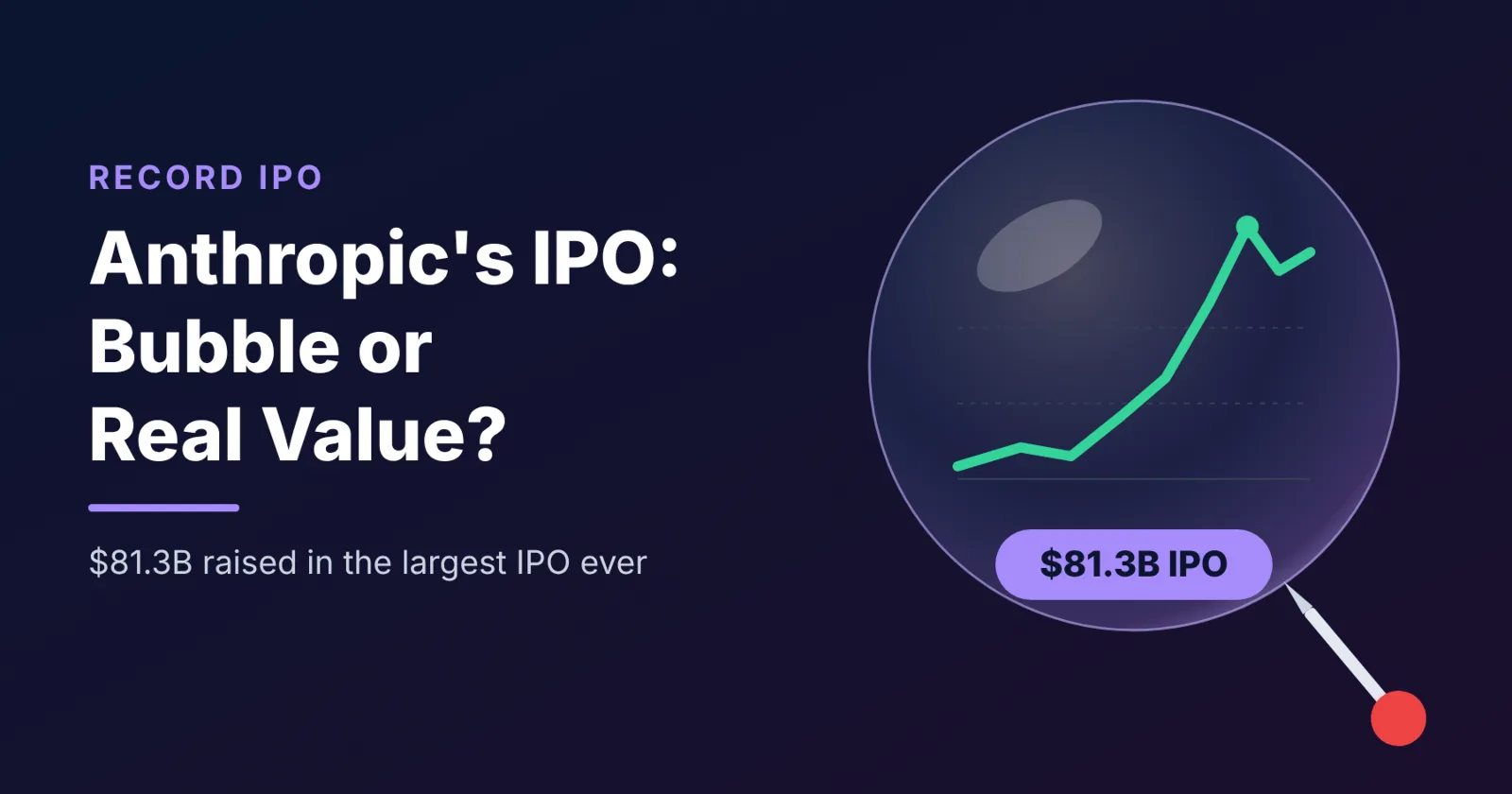
On Thursday, November 19, 2026, Anthropic, the company behind the Claude AI models, became a public company. It was not just any listing. Anthropic raised $81.3 billion, the largest initial public offering (IPO) ever, overtaking SpaceX's record-breaking debut in June.
In our earlier post, we asked whether AI is heading for a dot-com style burst. Anthropic's IPO is the biggest real-world test of that question so far. So which is it: a sign of a dangerous bubble, or proof that AI has become a genuine business?
The honest answer is that the IPO contains evidence for both.
The numbers at a glance
Anthropic priced its shares at $83, above the range it had originally marketed. Trading under the ticker ANT on the Nasdaq, the stock opened at $111.50, a jump of about 34 percent.
At its peak, that put Anthropic's fully diluted value at around $2 trillion, a figure that includes stock promised to employees but not yet vested. Based only on shares actually outstanding, the company was worth up to about $1.5 trillion, roughly on par with Tesla.
But the excitement cooled quickly. The shares closed the day at $97.17, still up 17 percent but well below the opening price, as early investors took profits. The next morning, the stock fell more than 6 percent in pre-market trading.
The backdrop matters too. On the same day as Anthropic's debut, the Nasdaq fell about 2.2 percent and closed at a seven-month low, as a broader sell-off hit AI and chip stocks.
The bull case: why this could be real value
1. Revenue is growing at an extraordinary pace
This is the strongest argument against the bubble theory. According to Reuters' review of the filing, Anthropic's revenue grew from $41 million in 2023 to $386 million in 2024, then to $4.59 billion in 2025. In the first half of 2026 alone, it brought in $16.29 billion, compared with $1.16 billion in the same period a year earlier.
Very few companies in history have grown this fast at this scale. This is the key difference from many dot-com startups, which listed with little or no revenue at all.
2. Losses are shrinking
Anthropic is still not profitable, but it is heading in the right direction. Its operating loss for the first half of 2026 narrowed to $693 million, down from $2.14 billion a year earlier, as revenue grew much faster than costs.
3. Businesses are paying for it
Most of Anthropic's revenue comes from businesses paying for its AI models based on how much they use them, plus paid subscriptions. Its early focus on coding helped it win a large share of enterprise customers. Data from the spending platform Ramp showed Anthropic accounting for more than 60 percent of AI token spending among the businesses it tracks in late October.
That is real money from real customers, not just hype.
The bear case: why critics see bubble warning signs
1. Enormous spending commitments
Computing power is Anthropic's biggest expense, and the commitments are staggering. The company has agreed to spend more than $600 billion with around eight partners over the next decade, including at least $110 billion with Amazon, about $114.5 billion with Google and $44.9 billion with Microsoft for cloud computing. Many of these agreements cannot be cancelled and require payment regardless of usage.
If AI demand grows more slowly than expected, those fixed costs could become a heavy burden.
2. Circular financing
This is the issue critics focus on most. Some of Anthropic's biggest suppliers are also among its biggest investors. Amazon has invested at least $13 billion and agreed to invest up to $20 billion more, while Google has committed up to $40 billion.
In simple terms, money flows from cloud giants into Anthropic as investment, then flows back to those same giants as spending on their cloud services. Critics argue that these circular deals can make demand for AI look stronger than it truly is. Supporters say it is a normal way to fund a capital-hungry industry.
3. A valuation built on expectations
Even after the revenue growth, a valuation of $1.5 trillion or more assumes Anthropic will keep growing extremely fast for many years. Before the debut, Morningstar estimated fair value at $92 per share and gave the stock a "very high uncertainty" rating. One IPO analyst suggested that some demand may simply reflect investors not wanting to miss out on a rare chance to own a leading AI company, even though long-term profitability remains uncertain.
4. Limited control for public shareholders
Anthropic is a public benefit corporation, which means it is legally required to balance profit with its mission of developing AI safely. After the IPO, its founders and an independent trust keep control through a special share class that carries 50.1 percent of voting power on key matters. Anthropic says concentrating control helps it manage AI risks. Critics point out that it also limits how much influence ordinary shareholders have.
So, bubble or real value?
Looking back at our dot-com comparison, Anthropic does not fit neatly into either box.
Unlike the typical dot-com company, Anthropic has huge, fast-growing revenue and a product that businesses use every day. That is not what a pure bubble looks like.
But the price investors are paying assumes years of near-perfect execution, and the company has locked itself into hundreds of billions of dollars in spending. The circular deals and the weak market reaction in the days after the IPO show that investors are nervous.
The most likely answer is this: the business is real, but the price is a bet. Whether that bet pays off depends on whether AI revenue keeps growing fast enough to justify the spending. If it does, today's valuation may look reasonable in hindsight. If growth slows, the stock could be one of the first places where an AI correction shows up.
What to watch next
Keep an eye on these signals in the coming months:
Quarterly results: As a public company, Anthropic must now report its numbers regularly. Revenue growth and the size of its losses will be closely watched.
The wider AI trade: The Nasdaq's slide to a seven-month low shows that sentiment around AI stocks is fragile.
OpenAI's plans: Anthropic's main rival is widely expected to consider its own listing. How investors respond will reveal how much appetite remains for AI stocks.
Interest rates: With the US Federal Reserve expected to raise rates in December, expensive growth stocks could face more pressure.
Frequently asked questions
How much did Anthropic raise in its IPO?
$81.3 billion, making it the largest IPO on record.
What was Anthropic's IPO price?
Shares were priced at $83. They opened at $111.50 and closed the first day at $97.17.
What is Anthropic's stock ticker?
Anthropic trades on the Nasdaq under the ticker ANT.
Is Anthropic profitable?
Not yet. It reported an operating loss of $693 million for the first half of 2026, though that was much smaller than the year before.
What is circular financing in AI?
It describes deals where companies such as cloud providers invest in an AI company, which then spends that money buying services from the same investors.
The bottom line
Anthropic's record IPO is both a celebration and a stress test for the AI industry. The revenue growth is real and remarkable. So are the spending commitments and the expectations built into the share price. The AI bubble debate is far from settled, and Anthropic's first year as a public company may go a long way towards answering it.
Disclaimer: This article is for information only and is not investment advice. Stock prices can rise and fall sharply, especially after an IPO. Always do your own research or consult a qualified financial adviser.