20 Nov 2026 · @Fasihuddin
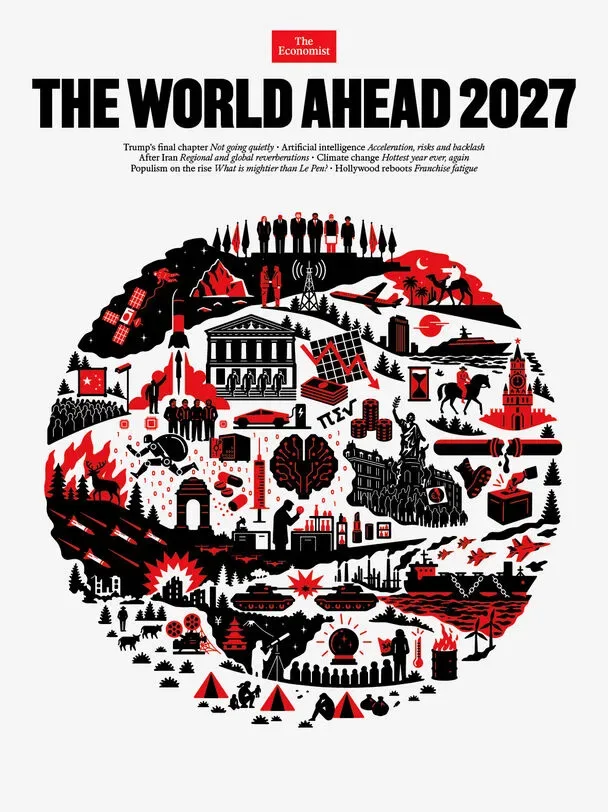
Every November, The Economist publishes The World Ahead, its annual guess at what the coming year will bring. The 2027 edition landed on November 17, 2026, and its tone is unusually blunt. Political upheaval in America, a possible showdown over Taiwan, cracks in government bond markets, an AI investment boom built on borrowed money, and a hungrier, hotter planet all feature on its crowded cover.
The headline idea is simple: 2027 marks the start of the post-Trump era, and the transition is unlikely to be calm. Here is what the magazine is warning about, and why it matters even far from Washington.
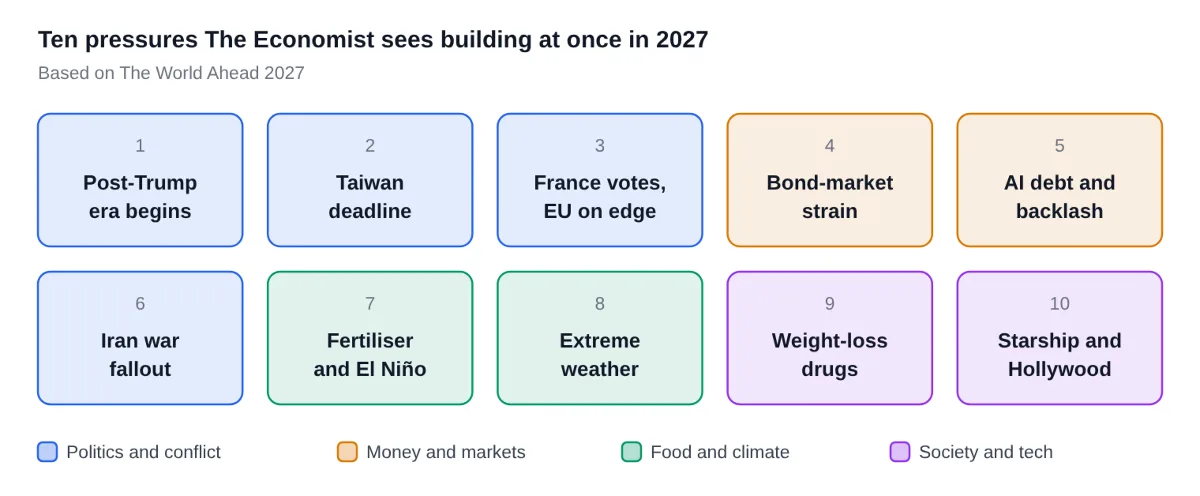
1. The post-Trump era begins, loudly
With Democrats now controlling both chambers of the US Congress, The World Ahead's editor Tom Standage argues that President Trump is unlikely to accept a shrinking role quietly. The magazine expects the opposite: more executive orders, more lawsuits, more grand building projects and more military action. At the same time, the race to succeed him will start in earnest. That is why the magazine frames 2027 as the opening chapter of America's next political phase rather than a simple continuation of the current one.
2. The Taiwan deadline
The year 2027 has long been cited as the date by which Xi Jinping wants China's military to be capable of taking Taiwan. The Economist is careful here: it does not predict an invasion. Instead it asks a sharper question. Wars in Ukraine and Iran have shown that drones and cheap modern weapons let smaller powers punch far above their weight. If that lesson holds, it could change Beijing's calculations about whether a takeover is even achievable.
3. France votes, and Europe holds its breath
France's presidential election is one of the year's big political tests. A victory for Marine Le Pen would, in the magazine's view, ripple across the European Union, especially by straining the Franco-German partnership that has long held the bloc together. France's heavy public debt adds a financial edge: political instability could spook investors at exactly the wrong moment.
4. The bond-market reckoning
This may be the most important warning on the list. Many rich countries have been spending beyond their means for years, and rising borrowing costs are now squeezing their budgets all at once. The Economist's point is that this cannot go on forever. A disorderly adjustment in government bond markets ranks among the main financial risks of 2027.
5. The AI backlash, and the AI debt pile
Public frustration with big tech is expected to grow. The magazine is particularly concerned about the mountain of debt that companies are taking on to fund AI, much of it through complex and opaque deals that could trigger a sharp fall in tech valuations. Interestingly, it also argues that some popular fears about AI destroying jobs or the environment are overblown. The real risk, in other words, may be financial before it is social.
6. The long shadow of the Iran war
The war in Iran will keep shaping diplomacy, energy prices and food supplies. According to The Economist, it has also dented allies' trust in Washington and changed how America's rivals see it.
7. Food insecurity: fertiliser shortages meet El Niño
A shortage of fertiliser, combined with a strong El Niño weather pattern, threatens food security for millions of people. This is one of the less flashy items on the cover, but potentially one of the most consequential for developing economies.
8. Another year of extreme weather
Expect more record heat, droughts, wildfires and heatwaves. There is a silver lining: turmoil in energy markets is likely to push more countries towards renewables, simply because they offer insulation from volatile oil and gas prices.
9. Weight-loss drugs reshape consumer markets
Drugs like Ozempic are moving beyond medicine. The magazine expects them to influence how people shop, with knock-on effects for clothing, cosmetics and the fitness industry.
10. Space gets busy, and Hollywood rethinks itself
The Economist expects SpaceX's Starship to begin regular satellite launches, the first private space station to go up, and the far-fetched idea of data centres in orbit to inch closer to reality. On Earth, Hollywood will keep reworking its big franchises as low-budget independent films keep finding success.
A word of caution about "the cover"
The Economist's annual cover is famous for attracting conspiracy theories, and 2027 is no exception. Some blogs have called it "creepy" and read it as a secret plan by global elites. That reading gets it backwards. The cover is a visual summary of the trends the magazine's journalists think are worth watching, not a prophecy, and plenty of past predictions have not come true.
It is also worth checking which cover you are looking at. Before the real issue appeared, an AI-generated fake "World Ahead 2027" cover spread widely on social media, and fact-checkers at Australia's AAP flagged it as false. If you share the cover, link to The Economist's own announcement.
Why this matters beyond the West
Many of these trends travel well beyond America and Europe. Higher global borrowing costs make it more expensive for emerging economies to refinance their debt. Fertiliser shortages and El Niño hit farm-dependent countries hardest. Energy price swings feed straight into inflation and fuel import bills. For countries like Pakistan, the most practical items on this list are probably not Taiwan or Hollywood, but bonds, food, fertiliser and weather.
The bottom line
The Economist's 2027 warning is not that disaster is certain. It is that several pressures are building at once: political transition in the world's most powerful country, fragile public finances, a debt-fuelled AI boom, and a climate that keeps getting harsher. Any one of them could dominate the headlines next year. The smart move is not to panic, but to watch the bond markets, the Taiwan Strait and the food supply a little more closely than usual.
Sources: The Economist's "The World Ahead 2027" (published November 17, 2026), as reported by UA.NEWS, AzerNews, Incrypted and others; AAP FactCheck on the fake cover.